

The Half Year Burn
31 days of auditing what's working, cutting what isn't, and staying focused in your marketing career.
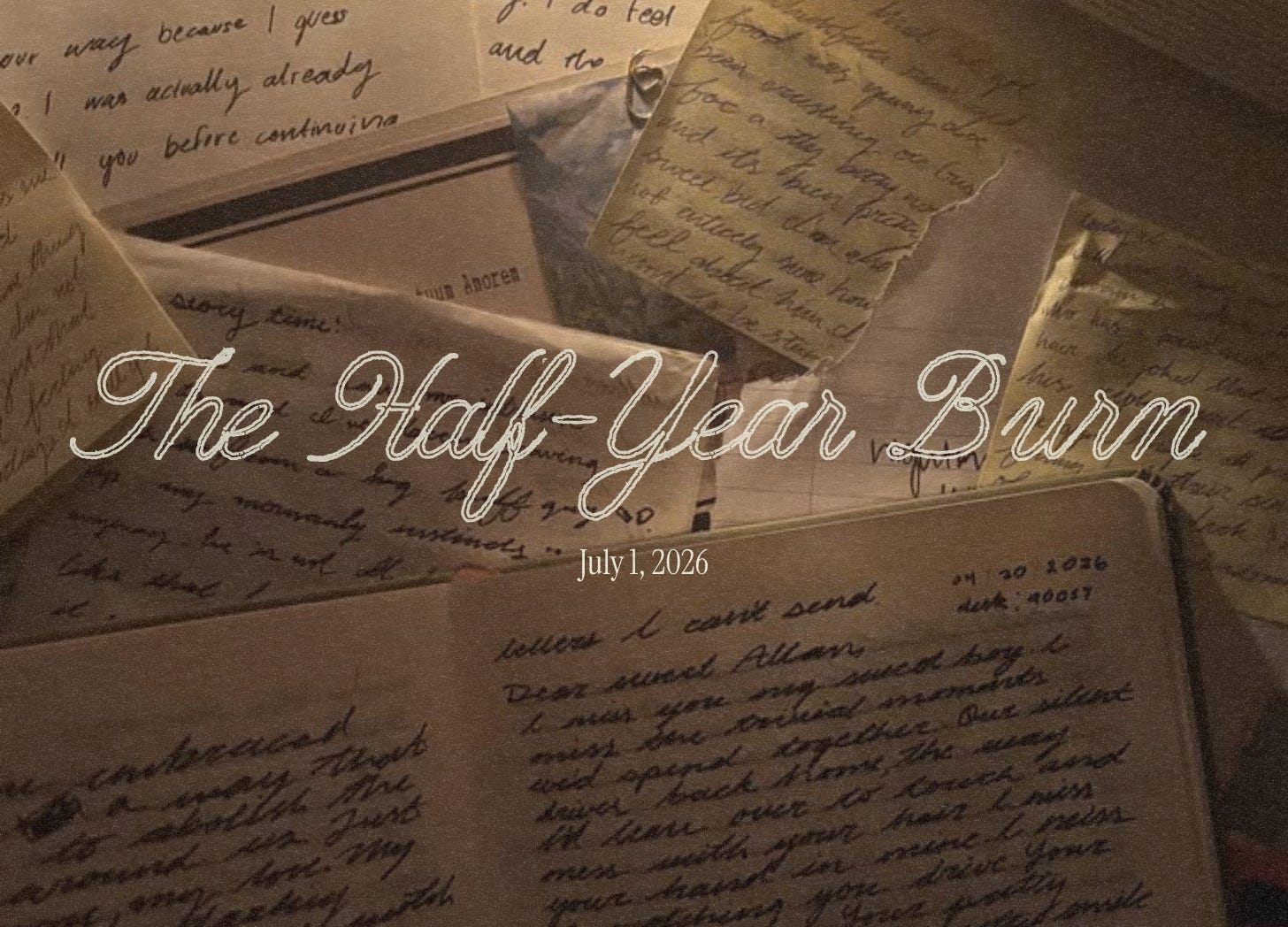
You are roughly halfway through the year. When July comes around its that ironic dichotomy of feeling like ‘How is it July Already?’ and ‘It’s only July.’
Journaling is a big part of keeping me sane between the insane news environment, breathing between sprints of understanding platform updates and working a full-time job and owning my own business on the side.
I hate the pressure that comes with January 1st and the forced ‘resets’ moving from Q4 to Q1 and balancing the sheer amount of audits that always feel like a good idea to put on the backburner until you return from the holiday break.
So, let me spare you the overwhelming feeling where hopefully there aren’t too many audits for you and you have the space and mental capacity to take a couple of minutes and channeling the audit energy of the accounts, the spend, the funnel, the creative, the competitors and audit ourselves.
So here’s your dashboard.
Thirty-one prompts, one a day, built to be done in July because the halfway mark is the cleanest reason you’ll get all year to stop and check the gauges. But this also works whenever this happens to come across your desk. January. A bad September. The Sunday you had a breakdown about because you know you’re not going to make a deadline.
The point is, this is not meant to be one giant audit. Take it slow. Please. Our attention spans and our vagus nerve needs it.
A full self-reckoning dropped on you in one sitting is just another overwhelming task, and you have enough of those.
This is one question a day. Some take two minutes. Some may sit with you longer than you’d ideally like. Get a piece of scrap paper, your favorite notebook, whatever it may be, in-hand, because something happens when it’s not a text field and there’s no autosave.
Here’s the breakdown.
Week 1 — The Reckoning.
Where you actually are, honestly, before you start fixing anything.
Week 2 — The Inspection.
Notice how I left the word audit out. We don’t need that buzzword hanging around us in this space. You’ll work through what’s working and what’s draining you, separated out so you can tell the difference.
Week 3 — The Subtraction.
What to cut, renegotiate, or stop carrying. Most of this work is removal, not addition.
Week 4 — The Expansion.
Where there’s actually room to grow, and what you want to be present for in a career that usually demands you be present for everything.
Days 29–31 — The Brief.
You pull it all together into a one-page read on where you are, where you’re going, and what you’re doing about it. A personal strategy brief, the kind you’d build for a brand, except this one’s for you.
A note before you start, because I know what a month of honest questions can stir up: some of these prompts may land on the realization that something’s wrong. That’s allowed.
The goal is leverage and clarity inside your life, not a resignation letter by Day 20. Almost everything that’s draining you can be renegotiated, reshaped, reclaimed, or set down without setting the whole thing on fire. We’re looking for what you can move. Keep that in your back pocket the whole way through.
Grab a notebook. One you actually like. See you on the other side of the month.
Week 1 — The Reckoning
Before you change anything, you have to know what you’re working with. This week is just looking. No fixing yet.
Day 1 — The honest weather report.
Forget the version you’d give in a standup. If someone you trusted asked how work is really going right now and you had no reason to perform, what would you actually say? Write the unedited answer.
For this, I encourage you to find at least twenty minutes to sit down and write two full pages, uninterrupted. It may feel forced and awkward to do this, but start slow and just let the words flow out of you, whether they mean something or not.
This is not a race towards perfection or wanting this to re-read well, but more so a place to let your brain unravel the knot of thoughts you have about what we spend 40+ hours a week doing.
Day 2 — When did you last feel good at this?
Not busy. Not productive. Good. The kind of day where you remembered you’re actually skilled at what you do. When was it, and what was happening? If you can’t find a recent one, let’s note that.
If you can’t, this data. I don’t want ‘failure’ to consume you and make you feel unworthy, because there is room for everyone here.
Day 3 — The thing you’re carrying that nobody sees.
There’s something you’re holding that doesn’t show up in any report.
A relationship, a dread, a project you’ve quietly given up on, a metric you’re scared of. Name it. You don’t have to solve it today. You just have to stop pretending it’s not there.
Day 4 — Where did the time actually go?
Think about a normal week. Where does your energy genuinely get spent versus where you assume it does? Most of us think we spend our day on strategy and spend it on Slack, reformatting decks, and explaining the same thing three times. Map the real one.
Day 5 — The comparison that’s eating you.
There’s a person, an account, a peer, a former coworker now doing something shinier. The one you watch a little too closely, maybe even with some envy.
Who is it, and what specifically does looking at them make you feel? Be precise. “Behind” is not specific enough.
Day 6 — What you’ve stopped noticing.
When everything is always-on, you go numb to it. What’s a stressor or annoyance you’ve fully normalized that an outsider would look at and say “wait, that’s not okay”? The notification at 9pm. The scope creep. The thing you just absorb now.
Day 7 — The gap.
Where’s the distance between the marketer you thought you’d be by now and the one you are? Don’t moralize it. Just measure it. Some gaps are a problem. Some are just an old map you never updated. Which kind is this?
Week 2 — The Audit
Now you separate signal from noise. Not everything that’s hard is bad, and not everything that’s easy is good. This week sorts it.
Day 8 — The list that lights you up.
Across everything you do, what are the tasks that you’d still want to do even on a hard day? The work that doesn’t cost you the way the rest does. List them honestly, even if they’re “small” or not the prestigious part of the job.
Day 9 — The list that drains you.
Now the opposite. What consistently leaves you flat, resentful, or exhausted in a way that’s disproportionate to how hard it actually is? Note which of these are hard because they’re complex versus hard because they’re misaligned with you.
Day 10 — What’s actually working.
Step back from the noise of constant change. What in your current setup, your routines, your role, your skills, is genuinely working right now? We’re so trained to optimize that we forget to clock the things we should protect. Find them before you go cutting.
Day 11 — The cost of staying current.
Every platform shift, algorithm update, new tool, and “you have to be on this now” takes a tax. What is keeping up actually costing you in hours, energy, and peace? And here’s the real question: how much of that keeping-up is necessary versus performed anxiety because everyone else seems to be doing it?
Day 12 — Who you’re really working for.
Not your employer. The actual humans whose approval, reaction, or opinion drives your day. A manager, a client, a stakeholder, a faceless internal audience. Who are you performing for, and is that performance earning you anything real?
Day 13 — The skill you’ve outgrown vs. the one you’re avoiding.
There’s something you’re great at that you’ve stopped finding interesting. And there’s something you keep circling but never commit to learning because it’s uncomfortable. Name both. The discomfort one is usually pointing somewhere.
Day 14 — The numbers conversation.
What you’re paid, what you’re worth, and what you tell yourself about the gap. When did you last get real about your rate or salary versus the scope you actually carry? Write down the number you’d ask for if you weren’t scared. Just the number. We’ll use it later.
Week 3 — The Subtraction
Most of the relief you’re looking for is on the other side of removal, not addition. This is the week you decide what to put down.
Day 15 — The thing you’d stop doing if no one would notice.
If you could quietly drop one recurring task, meeting, report, or responsibility and no one would say a word, what would it be? Now sit with the fact that you’ve been doing it anyway. Why?
Day 16 — The boundary you keep almost setting.
There’s a line you’ve meant to draw and haven’t. The hours, the response time, the scope, the one client or coworker who gets too much of you. What’s the boundary, and what’s the actual fear stopping you from setting it? Name the fear. It’s usually smaller in writing.
Day 17 — What you’re tolerating that you could renegotiate.
Not quit. Renegotiate. A workload, a tool, a process, an expectation. Pick one thing you’ve treated as fixed that might actually be a conversation you haven’t had yet. Most “I’m stuck with this” situations have never once been challenged out loud.
Day 18 — The yes you should have made a no.
Look back at a recent yes that you regret. What did it cost, and what was it really about? People-pleasing, fear, habit, the worry that saying no makes you replaceable? Find the pattern, because there is one.
Day 19 — The noise you can mute.
Your feeds, your follows, your inputs. What are you consuming that consistently makes you feel worse, more behind, or more anxious without making you better at your job? You’re allowed to mute the industry sometimes. What goes first?
Day 20 — The story you tell that isn’t serving you.
“I’m not technical.” “I’m bad at self-promotion.” “I always do this.” “It’s too late to pivot.” We all run a few of these on a loop. Catch one. Write it down. Then write down what it would mean if it simply weren’t true.
Day 21 — The permission you’re waiting for.
What are you waiting for someone to grant you that you could just decide to take? The title, the rest, the focus, the change, the day off you’ve earned six times over. Who exactly do you think has to sign off, and what happens if you stop waiting?
Week 4 — The Expansion
Now that you’ve made room, what fills it? This week is about growth that’s possible inside your real life, not a fantasy version of it.
Day 22 — The version of this job you’d actually want.
Same field, same general situation, but reshaped. If you could redesign your role or your business to fit how you actually work best, what changes? Stay realistic. This isn’t a different life, it’s a better-fitting version of this one.
Day 23 — The skill worth betting on.
Of everything shifting in this industry, what’s one direction you’d genuinely want to grow toward, not out of fear of being left behind, but because it interests you? Curiosity is a more durable engine than panic. What are you actually curious about?
Day 24 — Where you have leverage you’re not using.
You have more than you think. Experience, relationships, a track record, a niche, results you’ve never put into words. What’s a real source of leverage you’ve been sitting on? And what would using it look like?
Day 25 — The thing you make for everyone but yourself.
You build brands, audiences, and presence for other people all day. What would it look like to point even five percent of that skill at your own name, your own work, your own visibility? Not a side hustle. Just no longer being invisible in your own field.
Day 26 — Who you want in your corner.
Careers don’t expand alone. Who are the people, peers, mentors, a community, one honest friend in the work, that you want closer this half of the year? Name them. Then name the one you’ll actually reach out to.
Day 27 — What “present” would mean for you.
You’re asked to be present for everything, which means you’re rarely present for anything. If you could be genuinely present for just a few things in your work, the parts that matter most, what would they be? What would you let go fuzzy so those could stay sharp?
Day 28 — The smallest real change.
Forget the overhaul. What’s one small, concrete change you could make this week that your future self would thank you for? Small enough that you’ll actually do it. Specific enough that you’d know if you did.
Days 29–31 — The Brief
You’ve spent a month gathering. Now you compile. These last three days turn 28 scattered answers into one clear read on where you are and what you’re doing about it. Flip back through your notebook as you go.
Day 29 — Where you are.
Read back through Week 1 and 2. In a few honest sentences, write the state of things. Not the performed version. The real one. What’s working, what’s draining you, what you’ve been carrying, and how you’d actually describe this chapter if you had to name it. This is your situation, summarized by the only person with the full picture.
Day 30 — Where you’re going.
Read back through Week 3 and 4. What are you putting down, what are you protecting, and what are you growing toward? Pick the few that matter most. Not a wishlist. The two or three shifts that would change how this work feels. Write them as decisions, not hopes.
Day 31 — The brief.
Pull it all into one page. The same way you’d brief a brand, except this client is you. Fill in the template below in your notebook. When you’re done, you’ll have something you can actually return to, the thing this whole month was building toward.
The Half-Year Brief
Copy this into the last page of your notebook and fill it in.
Where I am right now: (One or two sentences. The honest read from Day 29.)
What’s working that I’m protecting: (From Day 10. The things I will not cut.)
What’s draining me that I’m addressing: (From Day 9 and 11. Name it, don’t bury it.)
What I’m putting down: (From Week 3. The boundary, the task, the yes-that-should-be-no, the story I’m done telling.)
What I’m renegotiating, not quitting: (From Day 17. The conversation I haven’t had yet.)
The number I’m worth: (From Day 14. Write it again. Look at it.)
What I’m growing toward, out of curiosity not fear: (From Day 23.)
The leverage I’m finally using: (From Day 24 and 25.)
The one person I’m reaching out to: (From Day 26. A name, not a category.)
The smallest change I’m making this week: (From Day 28. The one I’ll actually do.)
What I want to be present for: (From Day 27. The few things that get the sharp version of me.)
That’s the month.
You started here with a vague sense that something needed attention and you’re walking out with a page that tells you exactly what and exactly where. Keep it somewhere you’ll see it. Mid-September, when the noise is loud again and you’ve forgotten half of this, flip back. The version of you who did the work left notes.
This is the kind of audit nobody schedules for you. You did it anyway. I’m proud of you.
xoxo,
Mckenna